Husband and Wife Bible Study: A Simple 8-Week Plan to Do Together
A husband and wife Bible study works when it is simple enough to repeat. This guide gives you a plan you can start this week: one evening a week, the same five steps every time, eight passages on marriage, and one small action you actually do together.
Why most couples Bible studies fizzle out
Plenty of couples want to study the Bible together. The usual problems are practical, not spiritual: the devotional is vague, one spouse does all the talking, there is no set time, and the conversation never turns into anything you do differently. A study for husband and wife needs three things a solo devotional does not: time to think before you talk, a way to make sure both voices are heard, and something concrete to carry into the week.
The five steps of a husband and wife Bible study
Each week follows the same shape, so you always know where you are going. From the second week on, you also start with a short look back at last week's action.
- Read. Read the passage aloud, slowly, together if you can. Hearing it in your spouse's voice slows you down, which is part of the point. Then go through what the text actually says before anyone applies it.
- Reflect apart. Before you talk, each of you answers your own questions alone, in writing: one set for the wife, one for the husband. This is where you find out what you actually think before you find out what your spouse thinks. Skip it, and the quieter spouse often loses the floor.
- Talk together. Take turns. One speaks, the other listens; listening comes first. If you catch yourself preparing a reply while your spouse is still speaking, you have stopped listening. If the conversation needs to stop, pause it and agree when you will come back.
- Pray. A short prayer each, and one together. Short is deliberate: even in a crowded week you can still pray it.
- Act. Choose one small shared action for the week and write it down. Both of you choose it freely. Small is not a compromise; small is what actually gets done. Next week, look back at it before the new passage.
Text first, then talk. Everything else serves that order.
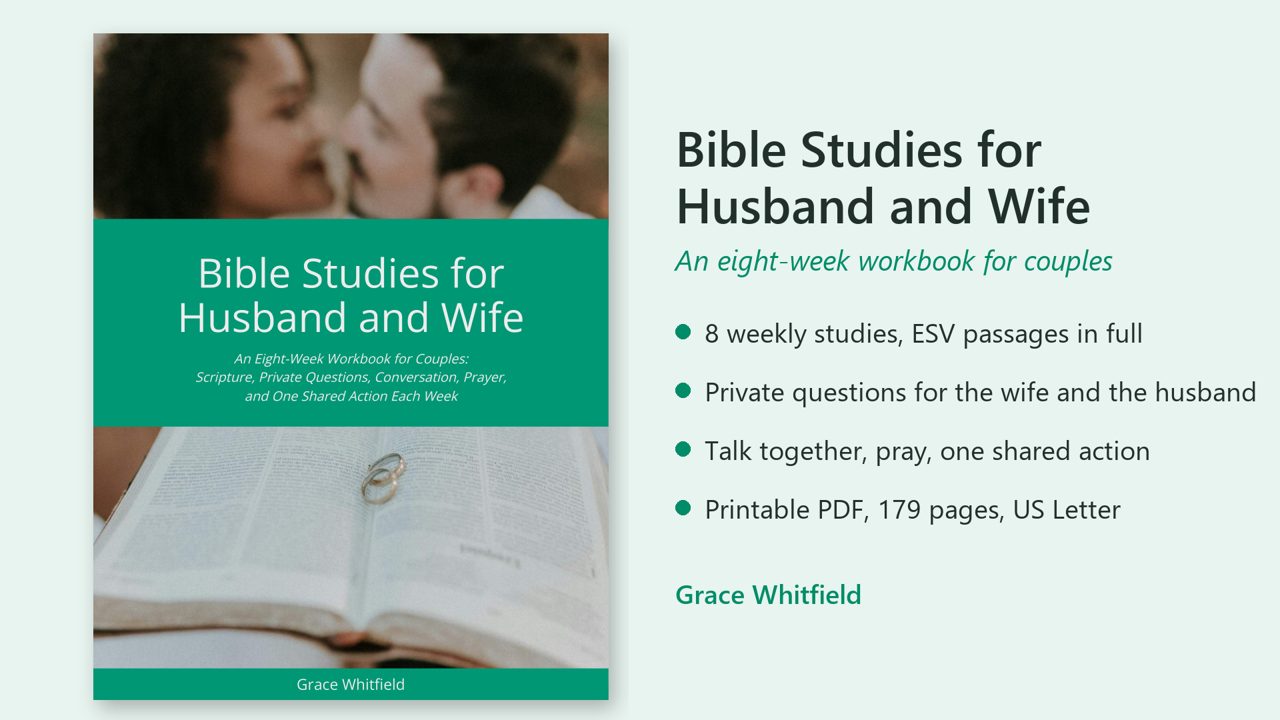
The complete husband and wife Bible study is a 179-page printable PDF (US Letter): all eight weeks, ESV passages printed in full, his and hers private questions, conversation guides, prayers and shared-action pages.
See the workbookTry Week 1 free
Two rules that keep a couples Bible study safe and honest
1. Keep what the passage says apart from how you apply it. The text says what it says; how it plays out in your budget, calendar and disagreements is a separate conversation. If you are not sure whether something is in the passage or in your reading of it, look at the text again and ask: is this stated here, or am I bringing it in?
2. Keep each spouse's instruction intact. When a passage speaks to wives and to husbands, read both sections out loud before discussing either. A wife who reads only what is said to her husband, or a husband who reads only what is said to his wife, has read a fragment, and fragments are how verses get used as weapons.
How much time a weekly couples Bible study takes
- Private reflection: about 20 minutes or more each, done beforehand, alone.
- First meeting together: about 90 minutes, because you are setting the pattern.
- Later meetings: about 60 to 75 minutes: 5 to 10 for the look back, about 15 for the passage, 30 to 40 for the conversation, and about 10 to pray and choose your action.
Busy week? With three minutes, read the passage aloud together. With twenty, read and reflect. With the full time, do the whole study. If you miss a week, do not double up; pick up where you left off. Nine or ten weeks instead of eight is not a failure.
Pick a standing time and put it on the calendar: Sunday evening, Saturday morning, a weeknight after the children are in bed. The day matters less than that it is an appointment rather than a hopeful intention.
An 8-week Bible study plan for couples
These eight passages move from companionship and commitment to partnership in difficulty. Some speak to husbands and wives directly; others are about love and companionship more broadly.
| Week | Theme | Passage (ESV) |
|---|---|---|
| 1 | Companionship and Commitment | Genesis 2:18-25; Matthew 19:3-9 |
| 2 | Submission, Love, and Distinct Instructions | Ephesians 5:21-33 |
| 3 | Understanding and Honor | 1 Peter 3:1-7 |
| 4 | Love Made Visible Through Humble Service | 1 Corinthians 13:4-7; Philippians 2:1-8 |
| 5 | Truthful Speech, Anger, and Forgiveness | Ephesians 4:25-32; James 1:19-20 |
| 6 | Compassion, Forgiveness, the Word, and Gratitude | Colossians 3:12-17 |
| 7 | Reciprocal Care and Sexual Intimacy | 1 Corinthians 7:2-5 |
| 8 | Partnership in Difficulty | Ecclesiastes 4:9-12 |
Week 1: Companionship and Commitment (Genesis 2:18-25; Matthew 19:3-9)
God says it is not good for the man to be alone and makes “a helper fit for him”; a man leaves father and mother, holds fast to his wife, and the two become one flesh. In Matthew 19 Jesus points back to that design: “What therefore God has joined together, let not man separate.”
Week 2: Submission, Love, and Distinct Instructions (Ephesians 5:21-33)
The passage opens with mutual submission “out of reverence for Christ,” then gives wives one instruction and husbands another: husbands are to love their wives as Christ loved the church and gave himself up for her. The workbook reads both instructions out loud before discussing either.
Week 3: Understanding and Honor (1 Peter 3:1-7)
Peter speaks to wives about conduct and the hidden person of the heart, and to husbands about living with their wives in an understanding way, showing honor, as heirs together of the grace of life, so that their prayers are not hindered.
Week 4: Love Made Visible Through Humble Service (1 Corinthians 13:4-7; Philippians 2:1-8)
Love is patient and kind, not arrogant or rude, and does not insist on its own way. Philippians asks each to count others more significant than themselves, following Christ, who took the form of a servant.
Week 5: Truthful Speech, Anger, and Forgiveness (Ephesians 4:25-32; James 1:19-20)
Put away falsehood and speak the truth; be angry and do not sin; do not let the sun go down on your anger; be kind and forgive as God in Christ forgave you. James adds: quick to hear, slow to speak, slow to anger.
Week 6: Compassion, Forgiveness, the Word, and Gratitude (Colossians 3:12-17)
Put on compassion, kindness, humility, meekness and patience; bear with one another and forgive; above all put on love; let the word of Christ dwell in you richly, and be thankful.
Week 7: Reciprocal Care and Sexual Intimacy (1 Corinthians 7:2-5)
Paul writes about husband and wife in matching terms, each giving the other their due and each with authority over the other's body, and says not to deprive one another except by agreement for a limited time, for prayer. The workbook's safety note applies here with particular force: no verse licenses pressure or coercion.
Week 8: Partnership in Difficulty (Ecclesiastes 4:9-12)
Two are better than one: if one falls, the other lifts him up; two together keep warm; and a threefold cord is not quickly broken.
How to start your husband and wife Bible study this week
- Agree on a weekly time and put it on a calendar you both look at.
- Get a copy of the private-question pages for each of you, plus a pen each. A Bible is welcome but not required if the passage is printed for you.
- Find a place where children, phones and the television will not interrupt you.
- Do your private reflection before the meeting, and keep your answers where your spouse will not read them first.
- Meet, follow the five steps, and write down one shared action.
If one of you is keener than the other, that is common and workable. The keen spouse can do the reading and reflection alone; the other is invited into the conversation, never forced. Use the study to open a door, not to make a case.
Want to see a whole week first? Week 1 is free here, with sample questions for the wife and the husband.
Safety note from the workbook. Nothing in these studies asks anyone to stay in danger, keep silent about abuse, or submit to violence, threats, sexual coercion or control. If you are afraid of your spouse, skip the joint conversations. In immediate danger call 911 (US), 999 (UK) or 112 (EU). US National Domestic Violence Hotline: 1-800-799-7233 (or text START to 88788). UK National Domestic Abuse Helpline: 0808 2000 247; Men's Advice Line: 0808 8010327.
The complete husband and wife Bible study is a 179-page printable PDF (US Letter): all eight weeks, ESV passages printed in full, his and hers private questions, conversation guides, prayers and shared-action pages.
See the workbookTry Week 1 free
Questions couples ask
How do you do a Bible study as husband and wife?
Pick one passage a week and follow five steps: read it aloud, answer your own questions privately in writing, talk it through taking turns, pray, and choose one small shared action to do that week. Start the next week by looking back at that action.
How long should a couples Bible study take?
Plan on about 20 minutes of private reflection each, then about 90 minutes for the first meeting together and 60 to 75 minutes for later ones. On a busy week, even reading the passage aloud together for three minutes keeps the habit alive.
What should a husband and wife study in the Bible?
Passages that speak to marriage and to love: Genesis 2:18-25 and Matthew 19:3-9, Ephesians 5:21-33, 1 Peter 3:1-7, 1 Corinthians 13:4-7 with Philippians 2:1-8, Ephesians 4:25-32 with James 1:19-20, Colossians 3:12-17, 1 Corinthians 7:2-5 and Ecclesiastes 4:9-12 make a good eight-week course.
Do we need a Bible or any training?
No training. You need a willingness to sit down together with the text in front of you. A Bible is welcome; any translation works if the study prints the passage for you.
Is a couples Bible study the same as marriage counseling?
No. It is a Bible study. If something in your marriage feels unsafe or is being pressed by Scripture in a way that feels wrong, talk to a pastor or counselor you trust, and if you are in danger contact a domestic abuse helpline.